I was first introduced to the Turbo Pascal compiler on CP/M computers while attending high school in the mid-1980s. By that time, I already had extensive experience with BASIC and Z80 assembly language—my first computer was a Sinclair ZX Spectrum—but I knew Pascal only from books.
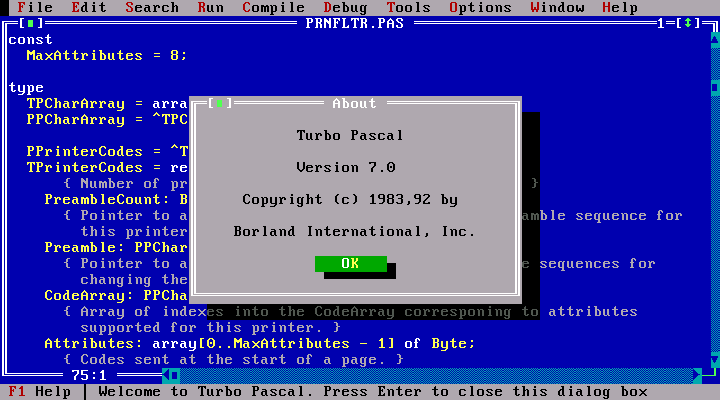
Turbo Pascal was truly impressive. It featured a full-screen editor, an elegant language, a remarkably fast compiler, and an excellent development environment. I immediately liked it and continued using Turbo Pascal and later Delphi, its successor, until Pascal gradually lost its popularity as a mainstream programming language.
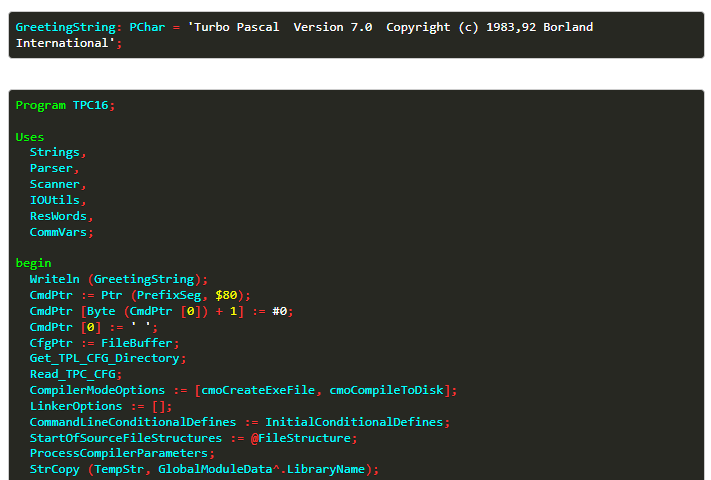
My interest in the Pascal programming language and compiler design eventually led me to reverse engineer the Turbo Pascal compiler. As a result, I created TPC16, a Turbo Pascal compiler written entirely in Turbo Pascal. It is compatible with Borland’s original Turbo Pascal 7 command-line compiler, TPC.EXE. Later, I modified the compiler to build under Delphi and renamed it TPC32. Building on this foundation, I subsequently developed Turbo51, a Pascal compiler for 8051 microcontrollers.
I later published my research on TurboPascal.org, documenting the internal architecture, algorithms, and data structures of the Turbo Pascal 7 command-line compiler. The credit for the elegance of the Pascal language and the exceptional design of the compiler belongs to Niklaus Wirth, Anders Hejlsberg, and Borland, whose work inspired this project.